

You train hard, climb four or five days a week, and wonder why your fingers ache and your sends have stalled. The answer almost always comes down to a missing structure. A periodized climbing training schedule organises your effort across weeks and months so you peak when it matters and recover before your body breaks down.
This tutorial walks you through every step — from self-assessment to building your annual plan, structuring mesocycles, programming microcycles, and recognising the warning signs of overtraining before they sideline you.
What Is Periodization and Why Does It Matter for Climbers?
Periodization is the systematic planning of athletic training that manipulates variables like load, volume, and intensity to maximise adaptation while preventing burnout. In climbing, the stakes are especially high because the sport simultaneously demands strength, endurance, technique, and mental focus — each with different recovery timelines.
The concept is rooted in Hans Selye's General Adaptation Syndrome (GAS), which describes the body's three-phase response to stress: Alarm, Resistance, and Exhaustion. A well-designed periodized plan keeps you in the Resistance phase — where growth happens — and steers you away from the Exhaustion phase that leads to injury and overtraining.
Without periodization, climbers risk plateauing, overtraining, or underdeveloping specific skills. A structured plan lets fatigue dissipate at key moments so your underlying fitness can express itself on the rock.
Understanding the Three Training Cycles
Every periodized plan is built from three nested time units. Getting comfortable with this hierarchy is the first practical step toward implementation.
Macrocycle — The Big Picture
A macrocycle is your entire season or annual plan, typically spanning six months to a year. It encompasses every training phase leading up to a major objective such as a bouldering trip, a sport-climbing project season, or a competition. Because of its length, you will always make adjustments as the year unfolds.
Mesocycle — The Training Block
Mesocycles are distinct phases within the macrocycle, usually lasting three to twelve weeks. Each block has a singular focus — for example, base-building for muscular endurance, a strength-development phase for improving grip strength, or a power phase for limit bouldering. The sequential ordering of these blocks is what drives long-term progress.
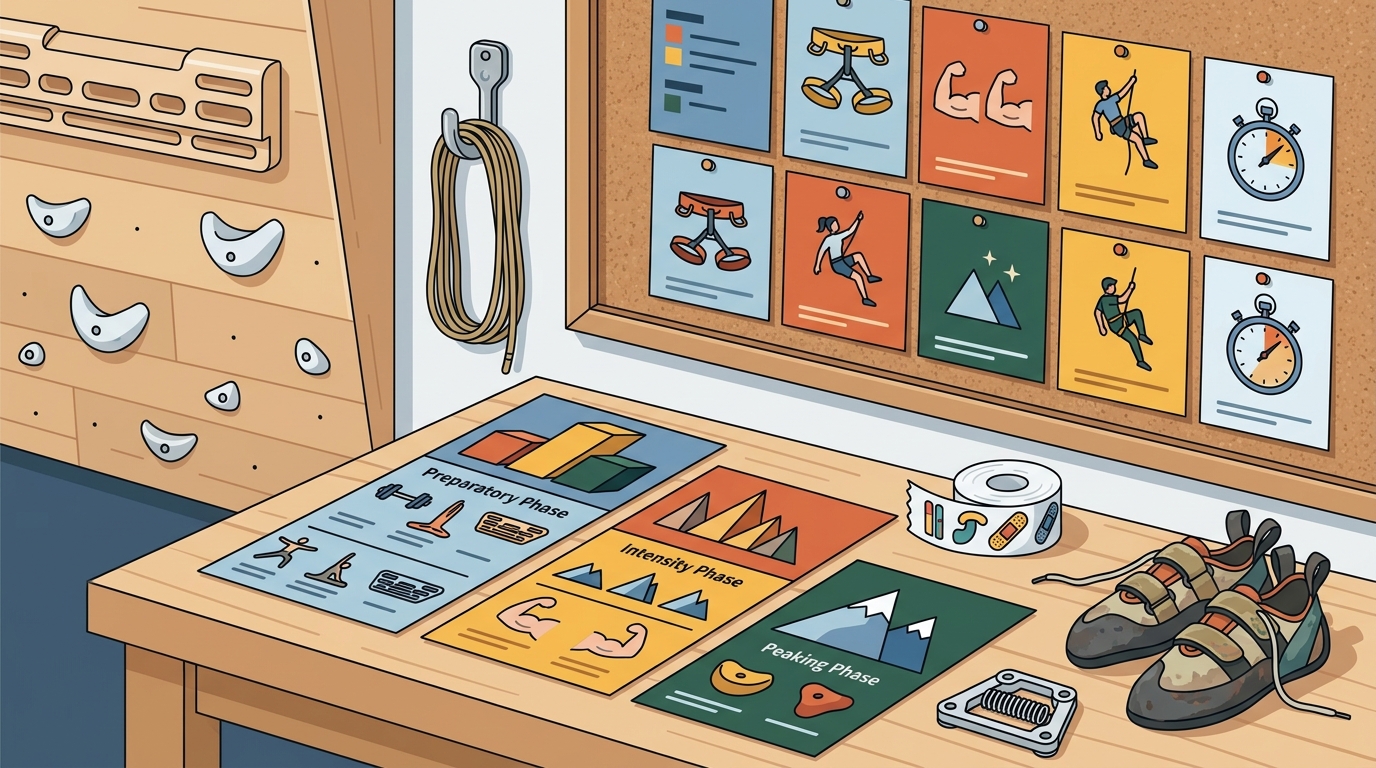
Microcycle — The Weekly Blueprint
Microcycles are the shortest training units, almost always one week long. A microcycle dictates your day-to-day schedule of workouts and rest days, integrating climbing sessions, supplemental strength training, mobility work, and recovery. A well-structured microcycle prevents overuse injuries common in climbers' elbows, shoulders, and fingers by ensuring proper recovery between demanding sessions.
Step 1 — Conduct an Honest Self-Assessment
Before choosing phases or writing workouts, you need to know where you stand. Skipping this step is one of the most common mistakes in climbing training.
- Physical benchmarks: Test your max finger strength on a 20 mm edge (weighted hang), your pulling strength via a weighted pull-up max, and your anaerobic endurance with repeater protocols to failure.
- Climbing benchmarks: Record your current redpoint grade, onsight grade, and the styles or angles where you struggle most.
- Lifestyle audit: Honestly evaluate your sleep quality (aim for seven to nine hours), nutrition habits, external life stressors, and weekly time available for training. Training capacity is as much about recovery resources as it is about motivation.
These baselines let you set realistic phase durations and identify the weaknesses your mesocycles need to target.
Step 2 — Map Your Annual Macrocycle
Work backwards from your goal. If your primary objective is an outdoor sport-climbing trip in October, mark that date and reverse-engineer every preceding phase.
A practical annual framework for a climber with one primary performance season might look like this:
| Phase | Duration | Primary Focus |
|---|---|---|
| Transition / Off-Season | 3–4 weeks | Recovery, mobility, easy climbing, mindset reset |
| Base Building | 6–10 weeks | Aerobic endurance, general strength, volume climbing |
| Strength & Hypertrophy | 4–6 weeks | Max finger strength, weighted pulls, antagonist work |
| Power & Specific Strength | 4–6 weeks | Limit bouldering, campus board (if appropriate), project-specific moves |
| Power Endurance | 3–4 weeks | Sustained hard climbing, linked sequences, route simulations |
| Taper & Peak | 1–2 weeks | Volume drop, intensity maintenance, travel to crag |
| Performance Season | 4–8 weeks | Projecting, onsighting, outdoor climbing with maintenance training |
Climbers targeting multiple performance peaks — say a spring bouldering trip and a fall sport-climbing trip — can run two shorter macrocycles separated by a mini transition block.
Step 3 — Design Each Mesocycle With a Single Focus
The power of periodization lies in focusing on one primary quality per block while maintaining others at a lower dose. Trying to maximise everything simultaneously often leads to overtraining because the cumulative volume overwhelms your recovery.
Base-Building Mesocycle (6–10 Weeks)
The goal here is building a foundation of aerobic capacity and work tolerance. Sessions revolve around ARC (aerobic restoration and capillarity) training — continuous moderate climbing for 20 to 45 minutes — supplemented with general strength work such as squats, rows, and push-ups. Effort stays in the 50–75 percent range with moderate to high volume. This phase also targets mobility restrictions and corrects technique flaws.
Strength Mesocycle (4–6 Weeks)
Intensity rises to 80–90 percent of your max while volume drops. Hangboard protocols (max hangs on a 20 mm edge for 7–10 second holds) become the centrepiece, paired with weighted pull-ups and supplementary lifts. Climbing shifts to harder problems with longer rest. Finger strength and tendon loading require longer recovery periods than cardiovascular work, so schedule at least 48 hours between high-intensity finger sessions.
Power & Specific-Strength Mesocycle (4–6 Weeks)
This block mimics the demands of your project. Limit bouldering, campus-board work for advanced climbers, and dynamic movement drills push intensity to 75–95 percent of max with very low volume. Rest periods between attempts stretch to three to five minutes to allow full neuromuscular recovery. Climbing becomes more specific — matching the angle, hold types, and movement style of your target routes or problems.
Power-Endurance & Peaking Mesocycle (3–6 Weeks)
The final training block before performance season. Sessions involve linked hard sequences, 4x4 protocols, and route simulations that tax both anaerobic capacity and mental fortitude. Volume is moderate but intensity is high. This phase ends with a one- to two-week taper: a significant drop in volume while maintaining intensity, letting accumulated fatigue dissipate so peak fitness can emerge.
Step 4 — Program Your Weekly Microcycles
Within each mesocycle, your weekly plan should balance stimulus and recovery. A practical template for a strength-phase microcycle might look like:
| Day | Session Focus |
|---|---|
| Monday | Limit bouldering + hangboard max hangs |
| Tuesday | Antagonist strength + mobility (push-ups, shoulder press, stretching) |
| Wednesday | Moderate climbing for technique + light core work |
| Thursday | Full rest |
| Friday | Weighted pull-ups + hangboard repeaters + easy volume climbing |
| Saturday | Outdoor climbing or project-style indoor session |
| Sunday | Full rest or active recovery (walking, yoga) |
Use Rate of Perceived Exertion (RPE) or Reps in Reserve (RIR) scales to adjust load up or down on any given day. If Monday's session felt like RPE 9.5 instead of the planned 8, consider dropping Wednesday's intensity or swapping it for a rest day.
Step 5 — Schedule Deload Weeks to Prevent Overtraining
Deload weeks are planned reductions in training volume (typically 40–60 percent of normal) inserted every three to five weeks. They are non-negotiable. Without them, fatigue accumulates faster than adaptation, pushing you toward overtraining syndrome.
During a deload, you still climb and train but at a markedly lower intensity and volume. Think easy bouldering, light hangboard work, mobility circuits, and extra sleep. Supercompensation — where performance temporarily dips after intense training but rebounds to a higher level after recovery — only occurs when you actually allow recovery to happen.
Practical deload strategies:
- Reduce climbing volume by 50 percent while keeping difficulty at roughly 70 percent of normal.
- Replace heavy lifts with bodyweight-only antagonist circuits.
- Add an extra full rest day.
- Prioritise sleep, nutrition, and soft-tissue work (foam rolling, massage).
Step 6 — Recognise Overtraining Warning Signs Early
Even with the best plan, life stress, poor sleep, or unexpected intensity spikes can tip you into overtraining territory. Watch for these red flags:
- Persistent fatigue that does not resolve after two rest days.
- Declining performance — grades dropping despite consistent effort.
- Increased resting heart rate or disrupted sleep patterns.
- Chronic soreness in fingers, elbows, or shoulders that worsens rather than improves.
- Loss of motivation or irritability around training.
- Frequent illness — the immune system is one of the first casualties of overtraining.
If you notice several of these signs, reduce training volume or intensity immediately. Treat unplanned illness or forced breaks as natural deloads. If you are sidelined for more than a month, repeat the previous mesocycle at reduced loads before progressing.
Choosing a Periodization Model: Linear, Block, or Undulating?
There is no single perfect periodization model. The best one depends on your experience, goals, and available time. Here is a concise comparison:
| Model | How It Works | Best For | Overtraining Risk |
|---|---|---|---|
| Linear (Sequential) | One quality at a time in distinct phases; intensity increases as volume decreases across the macrocycle | Beginners; climbers targeting one clear peak | Lower — focused stimulus with built-in volume reduction |
| Block | Concentrated mesocycles that develop overlapping qualities; each block builds on the previous one | Intermediate to advanced climbers with defined outdoor seasons | Moderate — higher overall volume demands careful load management |
| Undulating (Non-Linear) | Training focus changes daily or weekly within each microcycle (e.g., strength Monday, endurance Wednesday, power Friday) | In-season climbers; those needing all-around maintenance | Higher — frequent high-intensity variation can overwhelm recovery if unmanaged |
Many experienced climbers and coaches favour a conjugate approach that blends block and undulating elements — training a primary quality at high intensity while maintaining secondary qualities at lower doses within the same week.
Supplemental Training Within Your Periodized Plan
Effective periodization incorporates more than just climbing. Antagonist muscle exercises prevent the imbalances caused by repetitive pulling motions. Core stabilisation supports overhang performance. Cardiovascular conditioning during lower-intensity phases maintains general fitness without overstressing climbing-specific structures.
Align supplemental work with your current mesocycle:
- Base phase: Higher-volume general strength, cardio (running, cycling), extensive mobility work.
- Strength phase: Heavy compound lifts (deadlifts, rows), targeted shoulder prehab, reduced cardio.
- Power phase: Explosive movements (box jumps, medicine-ball throws), minimal cardio, injury-prevention circuits.
- Performance phase: Maintenance-level supplemental work only — save energy for sending.
Handling Real-Life Disruptions
No plan survives contact with reality unscathed. Periodization should be a flexible framework, not a rigid set of rules. Here are common scenarios and how to adapt:
- Vacation: Build it into your schedule as a deload. Bring a portable hangboard or plan bodyweight sessions to maintain finger contact strength.
- Illness (under one week): Treat it as a natural deload and pick up where you left off.
- Extended break (over one month): Repeat the most recent mesocycle at reduced intensity before advancing.
- Motivation drop: Revisit your assessments, adjust goals, and consider switching climbing styles temporarily for novelty.
The ability to adapt your plan based on results and how you feel is what separates sustainable training from chronic frustration.
Key Takeaways
- Periodization divides your training year into macrocycles, mesocycles, and microcycles — each with a distinct purpose that builds toward your peak.
- Start every plan with an honest physical, climbing, and lifestyle assessment.
- Focus each mesocycle on one primary quality while maintaining others at lower intensity.
- Schedule deload weeks every three to five weeks — they are when supercompensation and real gains occur.
- Monitor for overtraining signs such as persistent fatigue, declining grades, and frequent illness.
- Choose your periodization model (linear, block, or undulating) based on your experience level and goal timeline.
- Treat your plan as a living document: track, reassess, and adjust regularly.
Frequently Asked Questions
How long should a climbing training mesocycle last?
Most climbing mesocycles last between three and twelve weeks, depending on the quality being developed. Strength and power blocks often run four to six weeks, while base-building phases may extend to eight or ten weeks for climbers who need a larger aerobic foundation.
How often should I take a deload week?
Every three to five weeks of progressive training should be followed by a deload week where you reduce volume by roughly 40–60 percent. Connective tissue like tendons and ligaments adapts more slowly than muscle, so regular deloads are critical for injury prevention.
What is the difference between linear and undulating periodization for climbing?
Linear periodization develops one quality at a time in sequential phases — for example, an endurance block followed by a strength block. Undulating periodization varies the training focus daily or weekly within each microcycle. Linear is simpler and better for beginners or single-peak seasons, while undulating suits in-season climbers who need to maintain multiple qualities simultaneously.
Can I follow a periodized plan if I only climb three days a week?
Absolutely. Three climbing days interspersed with two supplemental strength or mobility sessions and two rest days is a highly effective microcycle structure. The principles of periodization — progressive overload, phase-specific focus, and scheduled recovery — apply regardless of total training volume.
How do I know if I am overtraining?
Common warning signs include persistent fatigue that does not resolve with rest, declining climbing grades, chronic joint or tendon soreness, disrupted sleep, frequent illness, and loss of motivation. If multiple signs appear, reduce training load immediately and prioritise recovery before resuming your plan.