
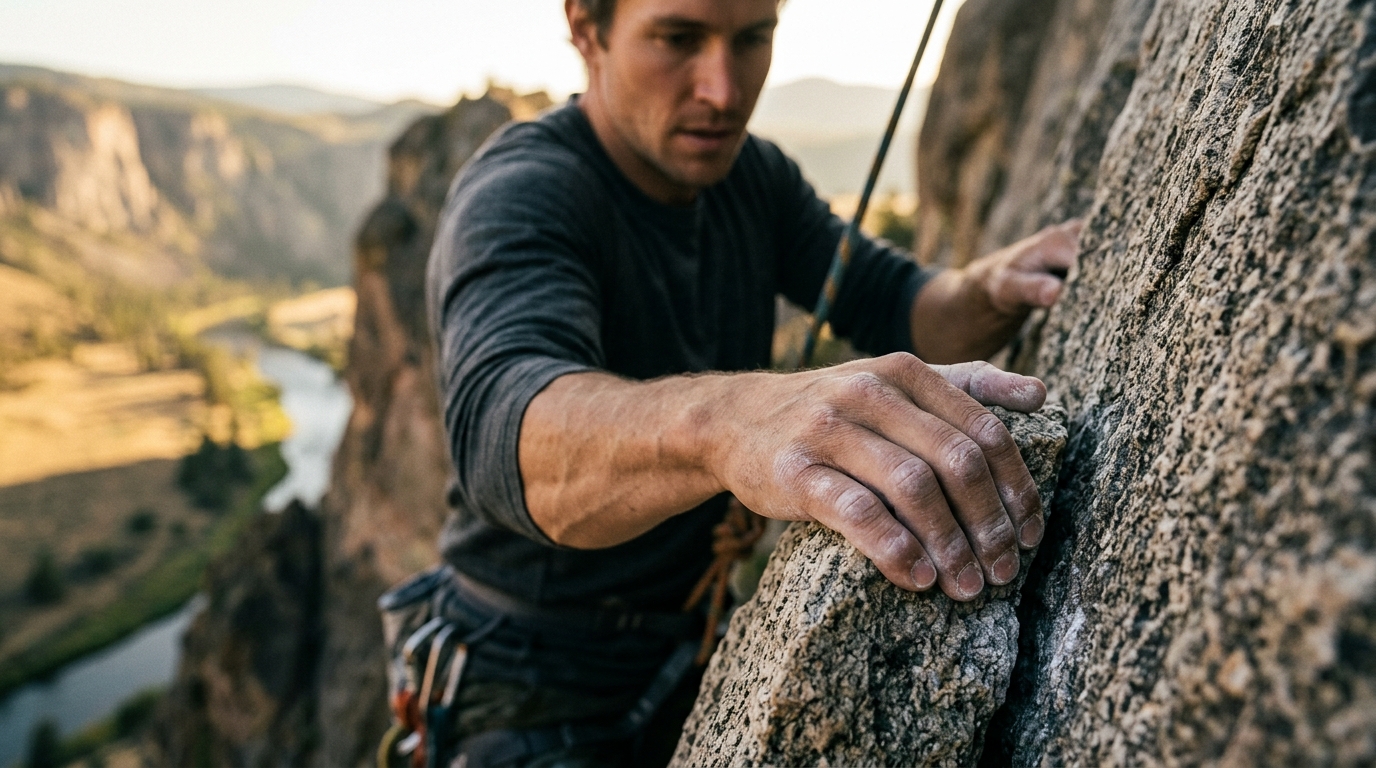
Sending your outdoor project demands more than just gym fitness. It requires purpose-built finger strength, polished movement skills, and a plan that ties everything together for real rock. This guide breaks down the research-backed methods and practical tactics that will help you turn indoor gains into outdoor sends.
Why Finger Strength Is the Single Biggest Physical Factor
If there is one physiological attribute that separates grade levels in climbing, it is how hard you can grip a small edge. A 2025 study in the European Journal of Applied Physiology found very strong associations between climbing-specific finger strength and bouldering performance (r = 0.89) as well as redpoint performance (r = 0.67). By comparison, general handgrip strength and pull-up strength showed only moderate or non-significant correlations with performance. The researchers concluded that isometric distal finger strength is the physiological factor most strongly related to both bouldering and redpoint performance in males.
What does this mean for your outdoor project? It means that dedicated finger training—not pull-ups, not general forearm work—delivers the highest return on investment when you are trying to hold smaller holds for longer on real rock.
Two Proven Hangboard Protocols: Max Hangs vs. Abrahangs
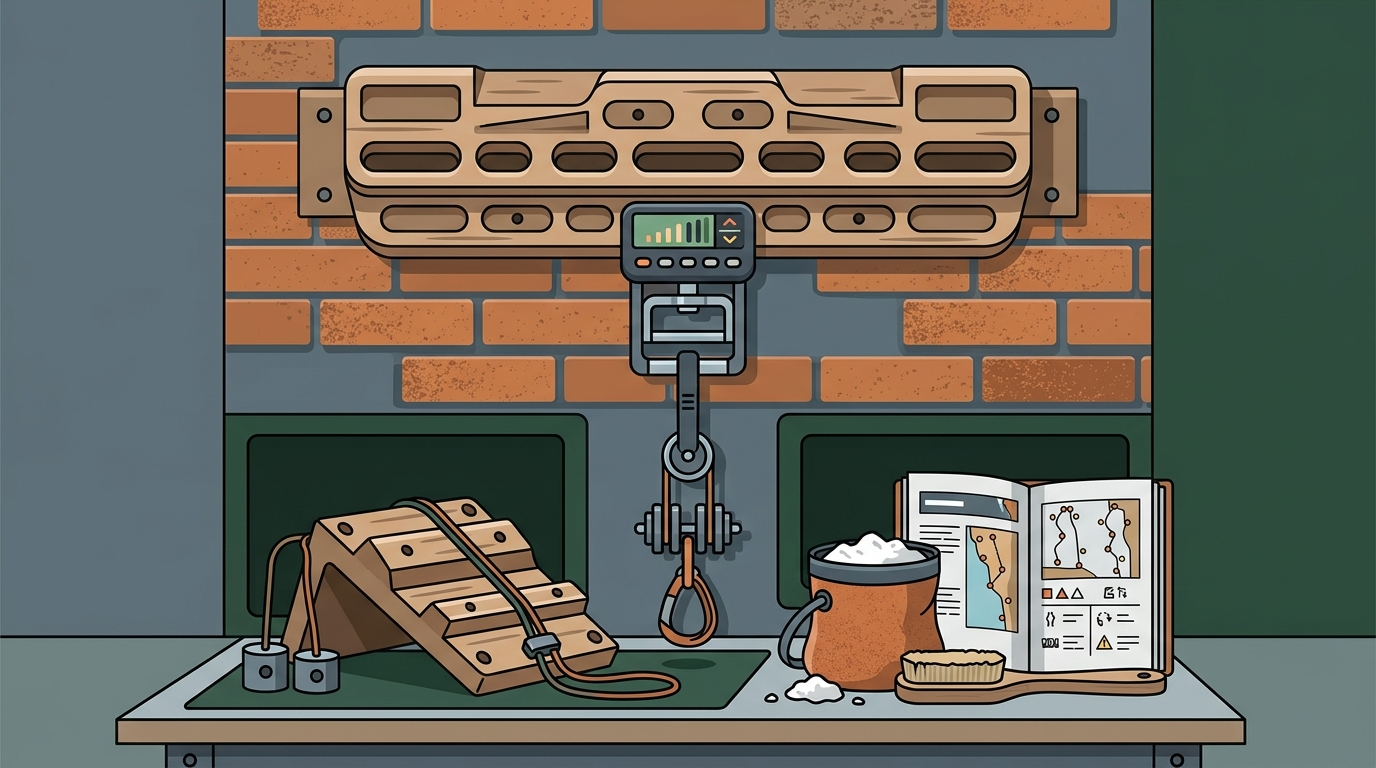
Hangboarding is the gold standard for isolated finger strength development. A large-scale 2024 study published in Sports Medicine – Open compared two protocols head-to-head and produced surprising results.
Max Hangs
The traditional approach involves holding an edge at 85–95% of your one-rep maximum for roughly 10 seconds per set. This protocol has long been central to finger strength training and is consistent with conventional heavy-load strength programming. The study confirmed that Max Hangs training produces improvements in finger strength compared to climbing alone.
Abrahangs (Sub-Maximal Daily Protocol)
Created by professional climber Emil Abrahamsson, this 10-minute protocol uses a far lighter load—around 40% of maximum, with feet remaining on the ground. Users perform the routine daily, with at least a six-hour window between the session and any climbing, to align with connective-tissue adaptation pathways. Remarkably, the study found that the increase in strength with Abrahangs was equivalent to Max Hangs, and performing both protocols concurrently produced additive gains.
Which Protocol Should You Choose?
| Factor | Max Hangs | Abrahangs |
|---|---|---|
| Intensity | 85–95% 1RM | ~40% max |
| Session Length | 15–25 min (with rests) | ~10 min |
| Frequency | 2–3× per week | Daily (away from sessions) |
| Joint / Tendon Stress | Higher | Lower |
| Best For | Experienced climbers with conditioned tendons | All levels; ideal supplement on rest days |
For outdoor projectors, running both protocols concurrently during a strength-building phase can maximise gains before your send season begins.
How to Reliably Track Your Finger Strength
You cannot improve what you do not measure. A 2025 systematic review in Frontiers in Sports and Active Living examined the reliability of finger-strength assessment methods and found that maximal isometric finger strength (MIFS) tests on fixed edges of 20–23 mm consistently demonstrate high reliability (ICC values 0.85–0.99). Testing each hand separately is recommended because bilateral protocols may mask strength asymmetries between hands.
Practical setup: Use a bathroom scale or portable dynamometer beneath a 20 mm edge. Warm up thoroughly, then perform three maximal 5-second pulls per hand. Record the peak value. Re-test every four to six weeks under the same conditions—same edge, same room temperature, same chalk routine—because even small environmental changes can alter results.
Protecting Your Fingers: The Injury Prevention Layer
Research on finger pulley injuries shows that climbers with fewer than six years in the sport who rapidly advance to the 7a+ level face elevated risk from intensive hangboard training. Climbers with a longer background appear to benefit from fingerboard training, which can help build stronger tendons and ligaments over time. The key principle is to introduce load progressively: start with the lightest effective dose and increase only when adaptation has occurred.
- Warm up thoroughly before any finger-intensive work—five minutes of easy traversing followed by ten minutes of progressive bouldering.
- Avoid crimping at full intensity on your first attempts of the day.
- Stop immediately if you feel sharp pain on the palmar side of a finger joint.
- Manage skin carefully on real rock—limit attempts on rough stone and use a skin-repair balm between sessions.
Building Technique That Transfers to Outdoor Rock
Finger strength is only half the equation. Without efficient movement, even strong fingers will burn out before you reach the anchors. Here are the technique pillars that matter most outdoors.
1. Precision Footwork
Outdoor footholds are rarely colour-coded. Learning to place and weight your feet on subtle features is crucial for reducing arm load. Practise placing and weighting your feet during your warm-up at the crag on an easier boulder to calibrate the pressure you need. Focus on using the tip of your toe on small footholds and weighting it fully so you can pivot and turn your hips into the wall for more reach and better balance.
2. Hip Engagement and Body Positioning
On steep terrain, think about driving your hips into the wall. The more fatigued you become, the more your hips can compensate for tired arms and legs. Techniques like the back step and drop knee keep your centre of gravity close to the rock and let you rest on straight arms—a critical skill on sustained outdoor routes.
3. Climbing on Varied Angles and Hold Types
It is tempting to stick to your strengths, but building an all-round repertoire is essential. Visit different crags with different rock types to expose yourself to slopers, pockets, pinches, cracks, and crimps. Climbing on varied terrain teaches you movement patterns that transfer directly to the unpredictable holds on outdoor projects.
4. Reading Sequences and Memorising Beta
Outdoor problems rarely offer a second-guess opportunity. When projecting, climb up to the troublesome section using good holds and try each difficult move repeatedly in isolation until you can stick it reliably. This drilling technique ensures your muscles and brain learn the movement, increasing the likelihood of linking the full sequence on your send go.
Deliberate Practice Over Random Mileage
Simply logging more wall time eventually leads to plateaus. Deliberate practice is a structured approach that demands focused attention and specific goals rather than mindless repetition. It involves identifying weaknesses, working on tasks that are challenging but achievable, and incorporating feedback.
Actionable steps:
- Film yourself climbing and compare your movement to stronger climbers on the same problem.
- Set process goals such as completing three focused footwork-drilling sessions per week rather than only outcome goals like sending a specific grade.
- Work 'anti-style' problems—if you excel on steep terrain, spend dedicated sessions on slabs and vertical faces.
- Limit attempts on your project to preserve skin and mental freshness. Quality burns beat quantity.
Seasonal Periodization for Outdoor Sending
The smartest approach for outdoor climbers is to split the year into training and performance phases. Use the off-season months to build finger strength indoors with hangboard protocols and board climbing, then allow outdoor climbing to take priority during the best part of the season when conditions are ideal.
A sample annual plan might look like this:
- Base Phase (8–12 weeks, off-season): High-volume easy climbing for movement quality. Add Abrahangs daily.
- Strength Phase (6–8 weeks): Max Hangs two to three times per week, board climbing for power, limit bouldering indoors.
- Power-Endurance Phase (4–6 weeks): Circuits, 4×4s, and outdoor-specific link-up practice.
- Performance Phase (season): Reduce supplemental training volume. Focus energy on outdoor sends. Maintain finger strength with one light hangboard session per week.
Key Takeaways
- Climbing-specific finger strength is the strongest predictor of both bouldering and redpoint performance—train it deliberately on a hangboard.
- Max Hangs (heavy, short holds) and Abrahangs (light, daily loading) both produce equivalent strength gains; combining them is additive.
- Test finger strength on a 20–23 mm edge every four to six weeks to track progress and detect asymmetries.
- Technique wins outdoors: invest in precision footwork, hip positioning, varied climbing styles, and beta memorisation.
- Use deliberate practice with process goals instead of mindless mileage.
- Periodise your year so that peak finger strength and technique coincide with your outdoor sending season.
Frequently Asked Questions
How long does it take to see finger strength gains from hangboarding?
Research shows that a 10-week intervention with specific finger flexor training can be effective at increasing a climber's specific maximal strength. Most climbers notice measurable gains within four to eight weeks when following a consistent protocol two to three times per week.
Is hangboard training safe for beginners?
Beginners should build a base of at least one to two years of regular climbing before intensive hangboarding. Climbers who advance rapidly to harder grades without sufficient tendon adaptation face higher injury risk. The Abrahangs sub-maximal protocol is a safer entry point because it uses only about 40% of maximum load.
Can I improve my outdoor climbing grade without a hangboard?
Yes—especially at lower grades. Climbing itself develops finger strength, and technique improvements often yield faster grade progression than raw strength training. Spending more time on the wall with focused footwork drills, varied climbing styles, and deliberate projecting can take many climbers to the V5–V7 range without supplemental training.
What edge size should I use for hangboard training?
Research consistently recommends edges of approximately 20–23 mm as a reliable and safe stimulus for standardised training and testing. Deeper edges are suitable for warm-up sets, while shallower edges (14–18 mm) can be used by advanced climbers for specificity.
How do I balance finger training with outdoor climbing days?
During your performance season, reduce hangboard volume to one maintenance session per week. Schedule it on a rest day or at least six hours away from a climbing session if using the Abrahangs protocol. Never hangboard at high intensity the day before an outdoor project attempt.