
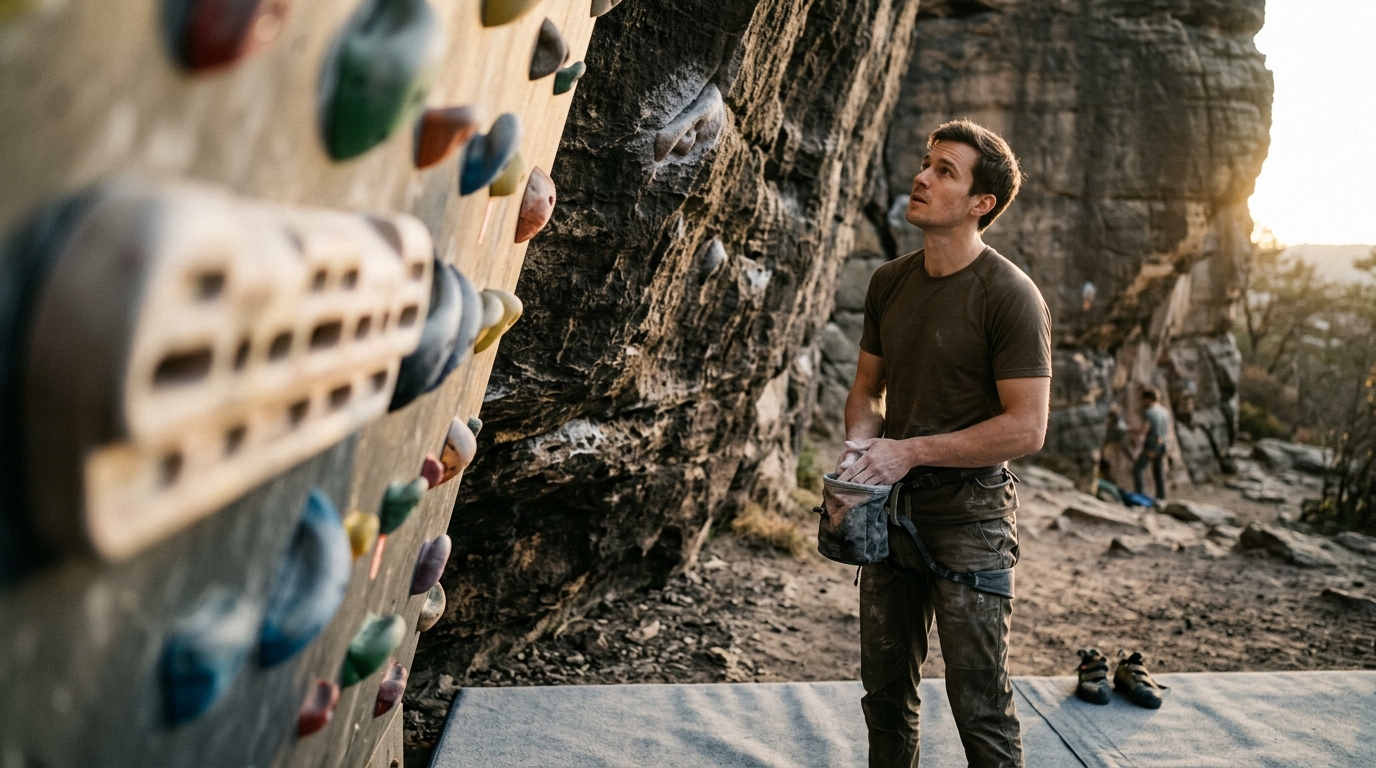
You have been crushing your gym projects all winter, but the moment you step onto real rock, everything feels harder. The footholds are invisible, the edges bite differently, and your forearms pump out two moves earlier than expected. Bridging the gap between indoor training and outdoor sends requires a two-pronged approach: developing stronger fingers through evidence-based protocols and refining technique with outdoor-specific practice. Here is the tactical plan.
Step 1: Understand Why Finger Strength Is Your Performance Ceiling
Before diving into protocols, it helps to understand what the science actually says. A 2025 study in the European Journal of Applied Physiology examined the relationship between finger strength and climbing grades in males ranging from 6b+ to 8c. The researchers found very strong correlations between climbing-specific finger strength and both bouldering performance (r = 0.89) and redpoint performance (r = 0.67). Importantly, general handgrip strength and pull-up strength showed weaker associations, meaning generic upper-body training is not a substitute for climbing-specific finger work.
The takeaway is clear: the force your fingertips can generate on a small edge is the single most predictive physical trait for how hard you can climb. Everything else — endurance, pull strength, core tension — plays a supporting role beneath that ceiling.
Step 2: Choose Your Hangboard Protocol (or Combine Two)
Two hangboard methods now have solid research support. Picking the right one — or layering both — depends on your schedule and training age.
Option A: Max Hangs
The classic approach involves hanging from a 14–23 mm edge at 85–95 percent of your one-rep max for roughly 10-second holds, with full rest between sets. This method has been the backbone of finger training for years and consistently produces strength gains in peer-reviewed studies.
Option B: Abrahangs (Sub-Maximal Daily Loading)
Created by professional climber Emil Abrahamsson and his brother Felix, this protocol calls for a 10-minute session of low-intensity hangs at approximately 40 percent of your max, with feet on the ground, performed almost daily. A 2024 study published in Sports Medicine – Open evaluated this protocol against Max Hangs using data from the Crimpd training app. The result was striking: the low-intensity Abrahangs protocol was as effective as Max Hangs at improving grip strength, and climbers who did both protocols concurrently saw additive gains.
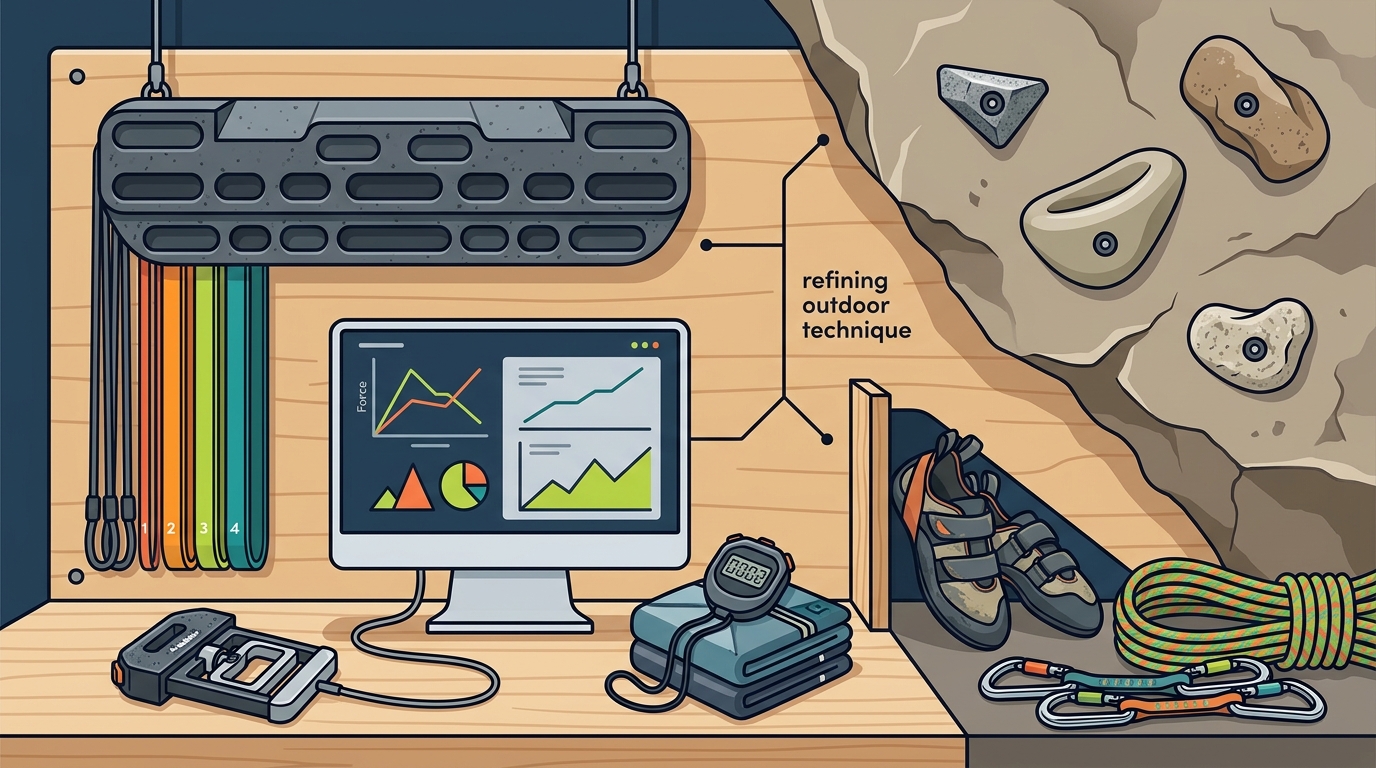
Option C: Run Both Concurrently
Given the additive findings, many climbers now stack Abrahangs on rest or easy days while performing Max Hangs twice per week on strength days. The key constraint is allowing at least a 6-hour window between Abrahangs sessions and any other climbing or hard training, to align with the connective tissue adaptation window the protocol was designed around.
Step 3: Test and Track With a Standardized Method
Gains you cannot measure are gains you cannot manage. A 2025 systematic review in Frontiers in Sports and Active Living analyzed the reliability of finger strength assessments across 14 studies and found that maximal isometric finger strength tests on fixed edges of 20–23 mm consistently demonstrated excellent reliability (ICC values of 0.85–0.99). The reviewers recommended testing each hand separately to detect asymmetries that bilateral protocols can mask.
Practically, this means you should:
- Use the same edge depth every time (a 20 mm edge on your hangboard is ideal).
- Control for temperature, humidity, and chalk usage between sessions.
- Test one hand at a time so you can spot strength imbalances before they lead to injury.
- Retest every 4–6 weeks to confirm that your program is working.
Step 4: Shift Your Technique Focus for Real Rock
Finger strength gives you permission to hold onto outdoor holds. Technique determines whether you need to hold on at all. Here is where indoor-trained climbers typically leak the most performance outside.
Precision Footwork on Natural Features
Outdoor footholds are rarely color-coded. Learning to trust small divots and smears is a skill that only develops through volume on real rock. One effective drill is to warm up on easy boulders at the crag and deliberately test how much pressure each foothold requires before it slips. This builds a mental library of textures and angles that no gym wall can replicate.
Hip Engagement and Momentum
Many climbers over-rely on upper-body pulling. On real rock, where holds are more varied and the angle changes unpredictably, efficient movement comes from driving with the hips and generating momentum through the legs. Practice thrusting your hips into the wall on every move during warm-up circuits until it becomes automatic.
Anti-Style Climbing
If you always gravitate toward steep overhangs, deliberately spend sessions on slab and vertical faces — and vice versa. Working problems that expose weaknesses builds a broader movement vocabulary. This concept of deliberate practice, applied to climbing, means selecting problems that target specific deficiencies rather than simply climbing what feels good.
Step 5: Build Volume on Real Rock Before Projecting
The most common mistake when transitioning outdoors is going straight to your goal grade. Instead, start at an area with a high density of problems across many grades and work through them methodically. Even if a climb goes on the first try, repeat it while refining footwork and body positioning. Volume of total moves on real rock is the fastest way to develop outdoor-specific technique and build the skin durability you need for extended sessions.
Step 6: Manage Your Skin Like a Finite Resource
Skin management is rarely discussed in training plans but it directly limits how many quality attempts you get on a project. Outdoor rock chews through fresh gym skin quickly. Practical tips include:
- Stop climbing before your tips go raw — pushing through costs you multiple future days.
- Use repair balms between sessions to accelerate recovery.
- Avoid aggressive drying agents unless you are an experienced climber who genuinely needs them for sweaty conditions.
- File down any flappers or rough spots after each session to keep skin surfaces even.
Step 7: Periodize Around Your Season
Tie all of these elements together with a simple seasonal structure:
| Phase | Duration | Focus |
|---|---|---|
| Off-Season (Hot Months) | 8–12 weeks | Max Hangs 2×/week, daily Abrahangs, anti-style gym climbing, mobility work |
| Pre-Season | 4–6 weeks | Reduce hangboard volume, increase outdoor mileage, build skin, rehearse projects |
| Send Season | 6–10 weeks | Maintain finger strength with 1 Max Hang session/week, prioritize rest and project attempts |
| Transition | 2–3 weeks | Active recovery, easy climbing, address any nagging tweaks |
This framework lets you build capacity when conditions are poor and deploy it when the weather turns prime for outdoor sends.
Key Takeaways
- Finger strength is the top physical predictor of climbing grade — invest in hangboard training with a proven protocol.
- Max Hangs and Abrahangs both work — and combining them produces additive strength gains.
- Test finger strength reliably by using a 20 mm edge, one hand at a time, every 4–6 weeks.
- Outdoor technique is a separate skill — build it through high-volume easy climbing on real rock before projecting.
- Periodize your year so that strength building happens in the off-season and sending happens when conditions peak.
Frequently Asked Questions
How long does it take to see finger strength gains from hangboarding?
Most research-backed protocols show measurable gains within 4 to 10 weeks. A study on intermediate to advanced climbers found that a 10-week hangboard intervention significantly improved climbing-specific maximal finger strength compared to climbing alone.
Should I use Max Hangs or Abrahangs for finger strength?
Both are effective. Research published in Sports Medicine – Open found Abrahangs (low-intensity daily hangs at ~40% max) produced strength gains equivalent to traditional Max Hangs (85–95% of 1RM for ~10 seconds). Performing both together produced the largest gains. Choose based on your schedule: Abrahangs are easier to fit into busy days, while Max Hangs require more focused sessions.
Why is my indoor grade higher than my outdoor grade?
Outdoor climbing demands precise footwork on irregular features, skin management on abrasive rock, and reading natural holds that are not color-coded. Conditions like temperature and humidity also affect friction. Building volume on real rock is the most effective way to close the gap between your indoor and outdoor grades.
How important is footwork compared to finger strength?
Finger strength sets your ceiling — it determines the smallest hold you can physically grip. Footwork determines how efficiently you use that strength. Excellent footwork reduces the load on your fingers for any given move, effectively making you climb as though you were stronger. Both are essential, but technique improvements often yield faster grade jumps for intermediate climbers.
Can I train finger strength without a hangboard?
Yes, but a hangboard is far more efficient for isolating finger load. Limit bouldering on small holds can build finger strength, but the extraneous movement means the stimulus is less targeted. If you have no hangboard, prioritize bouldering sessions on small-hold problems at your limit, keeping attempts short and rest periods long (3–5 minutes) to emphasize strength over endurance.