

Pre-Written vs. Personalized Climbing Programs: Which Is Better for Long-Term Progress?
Every climber eventually faces the same question: should you follow a pre-written training plan or invest in a fully personalized program? The answer depends on your experience level, goals, budget, and how quickly you want to break through plateaus. Pre-written programs offer structure at a lower cost, while personalized coaching addresses your unique weaknesses and adapts as you grow. In this comparison, we break down the pros, cons, and real-world outcomes of each approach so you can make a confident decision about your climbing future.
What Are Pre-Written Climbing Programs?
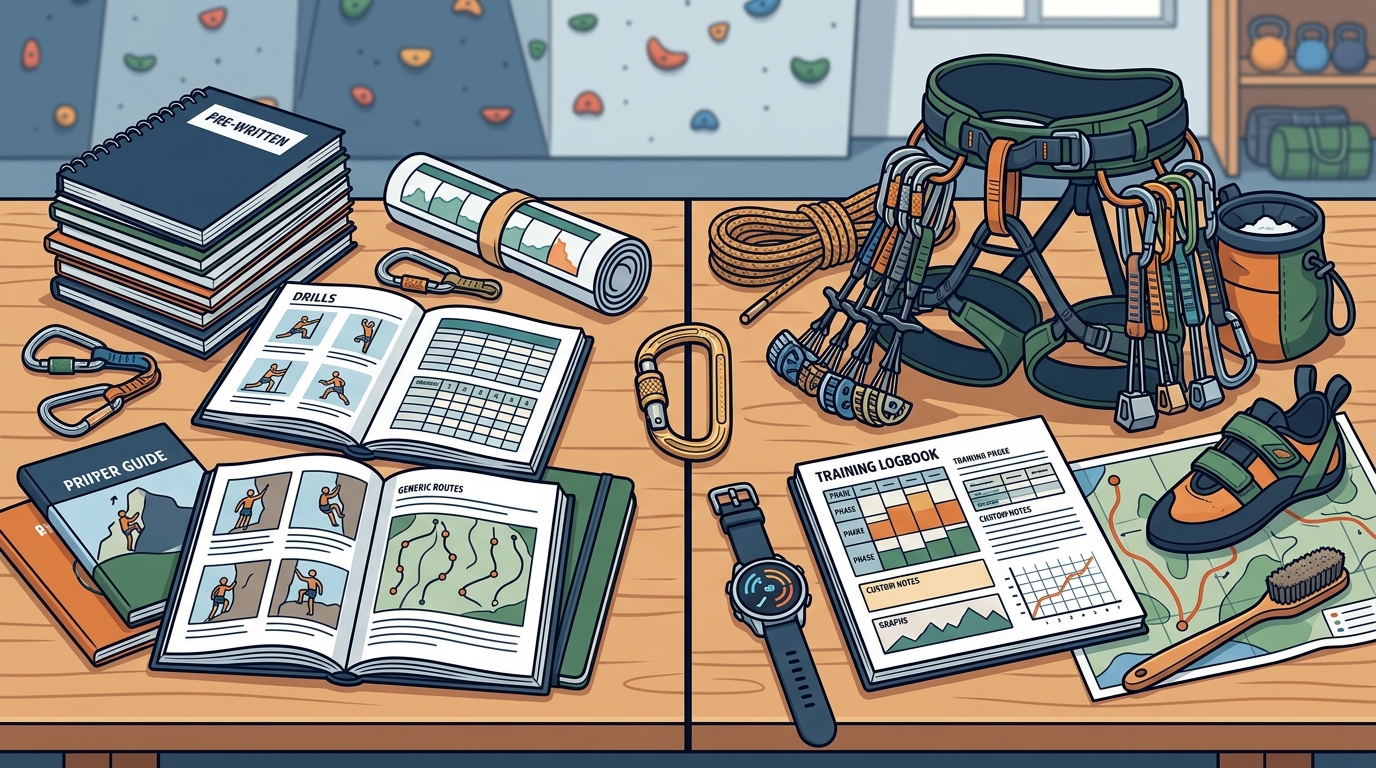
A pre-written climbing program is a structured training plan created in advance for a broad audience rather than a single athlete. These plans typically organize training into phases covering strength, power, endurance, and rest. Providers like Paradigm Climbing's Full Spectrum plan draw on experience coaching hundreds of athletes to build programs that work across ability levels.
Typical Structure
Most pre-written plans run in fixed cycles, often four to nine weeks, and include hangboard protocols, on-wall sessions, and conditioning work. They assume average recovery capacity, a standard weekly schedule, and no specific injuries. That makes them easy to start but harder to fine-tune mid-cycle.
Cost and Accessibility
Pre-written plans are significantly cheaper than coaching. Many range from free to roughly $20 per month, making them the most accessible entry point into structured climbing training. Services like TrainingBeta's subscription programs offer ongoing plans at that price tier.
What Are Personalized Climbing Programs?
A personalized climbing program is a training plan built specifically for one athlete based on an assessment of their strengths, weaknesses, goals, schedule, and injury history. The coach adjusts the plan cycle to cycle, sometimes week to week, based on how the athlete responds to training stimulus.
The Coaching Relationship
Personalized plans typically begin with a consultation. At Paradigm Climbing, for example, your coach schedules an initial consultation and then writes a fully customized plan organized in 9-week cycles. Elite-tier plans even include video analysis and movement feedback, giving athletes direct, ongoing input from their coach.
Why Individualization Matters
Two climbers at the same grade can have completely different needs. One may lack pulling strength while the other struggles with endurance and efficient movement. A personalized program identifies those gaps through assessment and targets them directly, which is something a generic template simply cannot do.
Head-to-Head Comparison
| Factor | Pre-Written Program | Personalized Program |
|---|---|---|
| Cost | $0 - $20/month | $50 - $200+/month |
| Customization | None to minimal | Fully tailored to the individual |
| Coach Access | Typically none | Regular check-ins, video review |
| Injury Adaptation | Not addressed | Plan adjusted around limitations |
| Plateau Management | Limited; same plan for everyone | Targeted weakness identification |
| Best For | Beginners or budget-conscious climbers | Intermediate to advanced climbers |
| Long-Term Progression | Effective early, diminishing returns | Sustained, compounding gains |
When a Pre-Written Plan Is the Right Call
If you are new to structured training, a pre-written program provides the discipline and routine you need without a large financial commitment. Beginners often make rapid gains from almost any organized stimulus because they have so much untapped potential. A general plan that introduces periodization, progressive overload, and rest protocols will outperform random gym sessions every time.
Pre-written plans also work well as a supplement. If you already climb frequently outdoors and just need a conditioning framework for off-days, a template plan fills the gap efficiently. Paradigm Climbing's Full Spectrum plans were built from insights gained coaching nearly 1,000 climbers, giving them a stronger evidence base than most generic templates.
When Personalized Coaching Wins
Once you move past the beginner phase, individual differences start to dominate your rate of improvement. A climber who trains only their strengths will hit a ceiling. Personalized coaching identifies the specific physical, technical, and mental gaps holding you back and programs around them.
Accountability and Adaptation
A coach who reviews your progress and adjusts your plan creates a feedback loop that no PDF can replicate. Coach Charlie Schreiber, founder of Paradigm Climbing and a CSCS with 16 years of coaching experience, has guided athletes from V0 all the way to V16 and V17. That kind of long-term athlete development requires continuous, individualized adjustment.
Injury Prevention
Climbing places enormous stress on fingers, shoulders, and elbows. A personalized plan accounts for your injury history and manages training load to reduce risk. Pre-written programs cannot do this, and finger pulley injuries or elbow tendinopathy are common consequences of following plans not calibrated to your body.
Common Mistakes Climbers Make Choosing a Program
Choosing based on price alone. The cheapest option is not always the most cost-effective. Months spent on a program that does not address your weaknesses are months of stagnation.
Sticking with a pre-written plan too long. General programs produce diminishing returns after the initial adaptation phase. If your progress has stalled for more than two full training cycles, it is time to consider coaching.
Assuming personalized means passive. Even with a custom plan, you still need to execute consistently. The coach provides the roadmap; you provide the effort. Paradigm Climbing's philosophy focuses on helping climbers understand why and how training works so they take ownership of their progress.
Key Takeaways
- A pre-written climbing program is a general plan built for a broad audience; a personalized program is built for you.
- Beginners benefit from pre-written plans because any structured training stimulus drives early gains.
- Intermediate and advanced climbers see greater long-term progress with personalized coaching that targets individual weaknesses.
- Personalized programs provide injury adaptation, accountability, and ongoing plan adjustments that templates cannot.
- Pre-written plans cost significantly less but offer diminishing returns as you advance.
- The best approach for many climbers is to start with a pre-written plan and transition to personalized coaching once progress plateaus.
- Paradigm Climbing offers both Full Spectrum pre-written plans and fully custom coaching, making it easy to level up when you are ready.
Frequently Asked Questions
What is the main difference between a pre-written and personalized climbing program?
A pre-written program follows a fixed template designed for a general population of climbers. A personalized program is written for one athlete after assessing their strengths, weaknesses, goals, and schedule, then adjusted over time based on their response to training.
Are pre-written climbing programs effective for beginners?
Yes. Beginners make fast progress with almost any organized training plan because the stimulus is new. A pre-written plan introduces structure, periodization, and recovery, which is far better than climbing without a plan.
When should I switch from a pre-written plan to personalized coaching?
Consider switching when your progress has plateaued for two or more training cycles, when you are dealing with recurring injuries, or when you have specific performance goals such as sending a project grade or competing.
How much does personalized climbing coaching cost?
Prices vary widely. Personalized plans typically range from $50 to over $200 per month depending on the level of coach interaction, video analysis, and plan complexity. Paradigm Climbing's custom plans are organized in 9-week cycles with options for different commitment levels.
Can I combine a pre-written plan with occasional coaching?
Absolutely. Some climbers use a pre-written plan as their base and add periodic coaching check-ins to refine technique or troubleshoot plateaus. This hybrid approach balances cost and personalization.
Do personalized programs help prevent climbing injuries?
Yes. A qualified coach adjusts training volume, intensity, and exercise selection based on your injury history and current physical state. This proactive approach reduces the risk of overuse injuries common in climbing, such as finger pulley strains and elbow tendinopathy.
What qualifications should I look for in a climbing coach?
Look for certifications like CSCS (Certified Strength and Conditioning Specialist), a strong personal climbing resume, and demonstrated experience coaching climbers at multiple levels. A long track record of athlete development, like Paradigm's roster of high-performance athletes, is a strong indicator of coaching quality.
Is long-term progress possible with only pre-written plans?
Some progress is possible, but most climbers will eventually plateau without individualized feedback. The more advanced you become, the more your specific weaknesses dictate your ceiling, and only personalized coaching can systematically address those.
Find the Right Plan for You
Whether you are just starting structured training or ready to break through a stubborn plateau, the right program makes all the difference. Explore Paradigm Climbing's Full Spectrum pre-written plans for an affordable entry point, or reach out to the coaching team to discuss a fully personalized training plan built around your goals. Your next grade is waiting.