
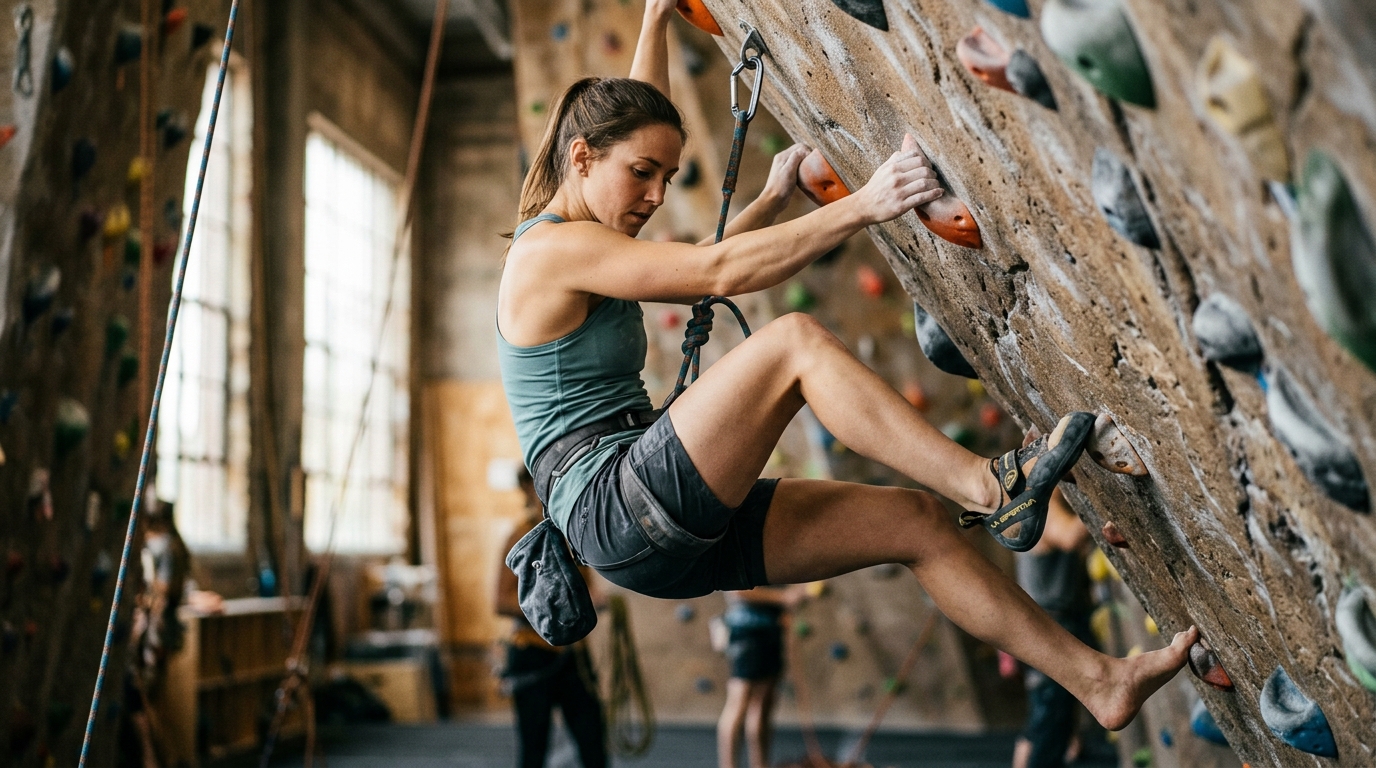
Sport climbing rewards precision over brute force. Two skills separate climbers who plateau at moderate grades from those who steadily tick harder routes: foot tension—the ability to actively pull and press through your toes on steep terrain—and body positioning—knowing how to orient your hips, shoulders, and centre of gravity so every move is efficient. Below you will find a curated set of on-the-wall and off-the-wall drills, organised by skill focus, that you can weave into your regular gym sessions or home workouts.
What Foot Tension Really Means
Many climbers assume tension is just a core-strength issue. In reality, tension is the coordinated effort of multiple muscle groups working together to resist gravity across your entire body. Your core, lower back, hips, glutes, hamstrings, calves, and even your toes must all stay engaged to keep your feet on the wall. The skill is both strength-based and technique-based, meaning you need to be strong and practised.
On steep terrain, novice climbers tend to use their lower body passively. On flat terrain with big holds this works, but as routes get steeper the approach fails. Instead, you should be digging into and pulling on footholds with your toes—imagine trying to rip them off the wall. Developing this active toe pull is what coaches mean when they talk about "foot tension."
Why Body Positioning Matters on Routes
Body positioning refers to how efficiently you orient yourself relative to the wall. Whether on a vertical face, a slab, or a 45-degree overhang, good positioning lets you leverage your centre of gravity, feet, core, and hands together. Sometimes twisting your hips lets you reach a hold, flagging a leg gives you balance, and engaging your core through a dynamic move prevents a fall. Understanding body position helps you plan your next steps so you can transition your weight intentionally and with maximum efficiency.
Hip extension is especially important on overhangs. By driving your hips close to the wall you shift the load from your arms to your legs, saving upper-body energy for the crux. Strengthening the posterior chain—calves, hamstrings, glutes, and lower back—supports this movement pattern.
On-the-Wall Foot Tension Drills

1. Silent Feet (Quiet Feet Drill)
This is widely regarded as one of the best footwork drills available. Climb any route or boulder problem two to three grades below your maximum and place every foot so softly that it makes no audible sound. If your foot thuds on a hold, stop and try the placement again until you can set it with full control. Practise this for at least 20 foot placements per set, three to five sets per session. Over time you will develop the habit of precise, intentional foot placement on every climb.
2. Sticky Feet (No-Readjust Drill)
Choose four routes two to three grades below your max. As you climb, the instant your foot touches a hold you are not allowed to move it. No readjusting, no picking it up—though you may pivot. If you break the rule, return your foot to the previous hold and try again. This builds "first-time accuracy" and forces you to look at each foothold before committing.
3. Foot-Only Tension Laps on a Spray Wall
Get on an overhanging spray wall, MoonBoard, or Kilter Board. Fix your hands on two holds and then move only your feet to different holds—aim for at least ten foot moves per set, using both inside and outside edges. Stand on holds as far away as possible to demand real body tension and foot pressure. Start with bigger holds and progress to smaller, slopier ones across three to five sets. You may be surprised at how much tension you need through your toes, mid-foot, and calves to maintain pressure on poor holds on overhanging terrain.
4. The Foot Lock Drill
This drill is about maintaining foot pressure through an entire climb with zero cuts. Attempt five to eight steep boulders near or slightly above your flash grade and complete each one without ever cutting feet. If your feet leave the wall, let go and restart. The climb does not count unless you send it with feet on the entire time. This teaches you to engage your lower body even through powerful moves.
5. Downclimbing for Foot Awareness
During your warm-up, downclimb every boulder or route you send. Focus on releasing as much weight as possible from your arms—let your feet lead and lower your body using your legs. Downclimbing naturally forces more deliberate foot placement and builds eccentric leg strength that translates directly to control on steep sport routes.
6. Three-Feet-Per-Hand Rule
On moderate routes, make three deliberate foot placements for every single hand move. You will likely need to add intermediate feet not part of the original route. This style trains you to keep your body close to the wall with your weight consistently on your feet, mimicking the small-foothold reality of outdoor rock.
Off-the-Wall Foot & Core Tension Exercises
7. Toe Drag with Weight Plate
Place a light weight plate on a smooth surface. While wearing climbing shoes, practise toeing into the edge of the plate and dragging it toward you, then pushing it away. This movement pattern teaches you to pull with your feet—the exact motion needed on steep walls where your toes must hook and pull against holds.
8. TRX or Ring Body-Line Extensions
Holding TRX handles or gymnastic rings, walk out to a challenging distance. Starting in an extended push-up position facing the floor, push the handles outward so your body makes an "I" shape, then return. This extension drill trains the full-body tension required to hold shape when stretched between distant holds on a route.
9. Plank Limb Taps
From a low plank position, tap various spots on the ground with your toes and fingers. Rotate through each limb and focus on keeping the rest of your body completely still during every tap. This drill builds the ability to isolate limb movement while maintaining trunk stability—exactly what you need when only one limb moves on the wall.
10. Big-Toe Mobility and Calf Raises
Your big toe has a direct effect on the kinetic chain running from your calves to your hips and lower back. If it is weak or lacking mobility, it can restrict muscles across the entire chain. Practise toe flexions daily—curl and bend your toes downward on one foot, ease your weight onto that foot, and lift the other foot off the floor. Pair this with slow single-leg calf raises to build the calf strength that holds your foot in tension when you push on a foothold.
11. Core-Engaged Reaching with Resistance Band
Lie on your back with a resistance band anchored overhead. Engage your core and counter the extension force by pressing into the band while reaching your arms overhead. This exercise strengthens the core muscles responsible for spinal stability and addresses lat tightness, helping you maintain optimal body alignment when reaching for holds on steep routes.
Body Positioning Drills
12. Hip-Shift Traverses
On a vertical or slightly overhanging wall, traverse back and forth while consciously shifting your hips over your active foot before every hand move. Feel the energy of each move start from your hips, not your arms. Experiment with turning your hips into the wall (twist-locking) versus squaring up, noting which orientation lets you reach farther with less effort.
13. Flagging & Drop-Knee Isolation
Backsteps, flags, and drop-knees all shift the position of your hips and centre of balance. On easy terrain, climb a route and force yourself to use a flag or drop-knee on every move, even where it is not strictly necessary. Over-exaggerating these positions builds muscle memory so they become reflexive on harder routes where you need them most.
14. One-Arm Traverse
While traversing on large holds on a slightly overhanging wall, climb with only one arm. After completing the traverse, switch to the other arm. This drill is deceptively difficult and teaches you to position your body over your feet precisely—if your centre of gravity is not aligned, you simply will not stay on. Progress by increasing the wall angle and hold spacing over time.
15. Eyes-on-Feet Drill
Climb a route or boulder at a comfortable grade and intentionally look at every foothold before you place your foot on it. Once placed, keep staring at it for three seconds before looking away. This feels slow but it trains the habit of directing visual focus to your feet—critical because many climbers take their eyes off the foothold before their foot even arrives, leading to poor placement.
16. Cow Stance & Synched Drop-Knee Drill
On a slightly overhung wall, start in a neutral position with good hand- and footholds. Reach up and right with your right hand while dropping your right knee down and inward, pressing hard through your toes. Focus on making the movement fluid and synchronised. Reset and try the other side. This over-exaggerated motion trains you to engage core, hips, back, and toes in unison through complex position changes.
Sample Session Plan (60–75 Minutes)
| Phase | Drill | Duration / Sets |
|---|---|---|
| Warm-Up | Easy routes with Silent Feet focus + downclimbing | 15 min |
| Footwork Block | Sticky Feet drill (4 routes) → Foot-Only Tension Laps (4 sets of 10 moves) | 20 min |
| Body Position Block | Hip-Shift Traverses (3 laps each direction) → Flagging Isolation (3 routes) | 15 min |
| Strength Block | Plank Limb Taps 3×10 each limb → TRX Extensions 3×8 → Single-Leg Calf Raises 3×12 | 15 min |
| Cool-Down | Big-toe mobility, hip stretches, light traversing | 5–10 min |
Key Takeaways
- Tension is full-body, not just core. Your glutes, hamstrings, calves, and toes are all part of the chain.
- Train below your max. Most footwork and positioning drills should be done two to three grades below your limit so technique—not strength—is the bottleneck.
- Look at your feet. Many climbers look away from a foothold before their foot arrives. Deliberate visual focus is a habit you must build.
- Overexaggerate in practice. Drills like forced flagging or cow stances feel awkward but embed positioning reflexes that appear when you need them on hard routes.
- Use steep terrain. Spray walls, board climbing (MoonBoard, Kilter Board), and overhanging boulders provide the best arena for foot-tension practice.
- Consistency beats intensity. Run two or three drills per session over many weeks rather than cramming every drill into one marathon session.
Frequently Asked Questions
What is foot tension in climbing?
Foot tension is the ability to actively press and pull through your toes and feet to resist gravity on the wall. It involves your core, hips, glutes, hamstrings, calves, and toes working together to keep your feet engaged, especially on steep terrain.
Can I improve foot tension without a climbing wall?
Yes. Off-the-wall exercises like toe drags with a weight plate, TRX body-line extensions, plank limb taps, and big-toe mobility work all develop the muscles and coordination needed for foot tension. Pair them with climbing sessions for best results.
How often should I practise footwork drills?
Incorporate two or three drills into every climbing session. Use them during your warm-up or as a dedicated technique block before you start projecting. Most coaches recommend doing footwork drills at least two to three times per week for steady improvement.
What is the best drill for body positioning?
Hip-shift traverses and forced flagging are among the most effective because they train you to move from your hips rather than pulling with your arms. Combining these with the eyes-on-feet drill creates a powerful feedback loop between visual focus and body alignment.
Do I need special equipment for these drills?
Most on-the-wall drills require nothing beyond a climbing wall and shoes. For off-the-wall work a weight plate, TRX straps or rings, and a resistance band are helpful but not essential. A spray wall or climbing board (MoonBoard, Kilter Board) is ideal for foot-tension laps but any overhanging bouldering wall works.
Should I do drills on easy or hard routes?
Technique drills are most effective on routes well below your maximum—typically two to three grades easier. This lets you focus entirely on movement quality without being limited by strength or pump.